Birdwatching news and bird photography from Azerbaijan- by Kai Gauger and Michael Heiß

Donnerstag, 12. Februar 2015

Winter trip 2015. First days: Gobustan and Shirvan National Park

Text © K. Gauger & M. Heiß

Arriving at Baku Airport in the early morning of 16th January we immediately received our cars, which have been organised by our tour operator Kaspian Tur. For the ten participants of the trip we rented three 4WD cars. After a brief instruction we had a nice night drive through Baku city just before the rush hour started.

Our first stop was at the famous Gobustan rock engravings. These are thought to be impressive 5.000 to 40.000 years old. Besides the outstanding cultural value the spot is also excellent for bird watching. The rocks are year-round highly attractive to a large variety of species, especially rock-specialists like Rock Nuthatches that were audible everywhere, Rock Buntings of which we saw 7 in a flock or 2 pairs of Finsch’s Wheatear.

Rock formations in Gobustan © Michael Heiß
Rock Bunting © Kai Gauger
Western Rock Nuthatch © Kai Gauger
Crested Lark © Kai Gauger
Some wintering species were in the rocks as well: Chaffinch, Sparrow Hawk, Wren, Dunnock, Robin, Song Thrush, Redwing, 2 Goldcrests, 7 Wood Larks and more than 20 Black Redstarts. Pairs of Red-billed Choughs flew over and a pair of Spanish Sparrows showed up well at the visitors centre. Nevertheless, we missed the Wallcreeper that we have seen on our last wintertrip in 2010.

We headed further south for the next stop in the Shirvan National Park. Several groups of gazelles were around as usual but two distant wolves were a nice surprise. Among the passerines we found mainly Corn Buntings, Meadow Pipits and Common Linnets. Hen Harriers and Merlins were frequent. A first flock of about 3.000 Little Bustards flew in some distance. A stop in the steppe produced flocks of larks, dominated by Skylark and Calandra Lark, but also 3 or 4 White-winged Larks were among them. This species was a main target for some of us but unfortunately only a few saw them. 9 Lesser White-fronted Geese were among hundreds of Greater White-fronted and Greylag Geese. 

Roadside birding without birds © Lukas Pelikan
Roadside birding with Little Bustards © Michael Heiß
Always drive slowly when Little Bustards cross the road © Lukas Pelikan
Goitered Gazelles © Michael Heiß
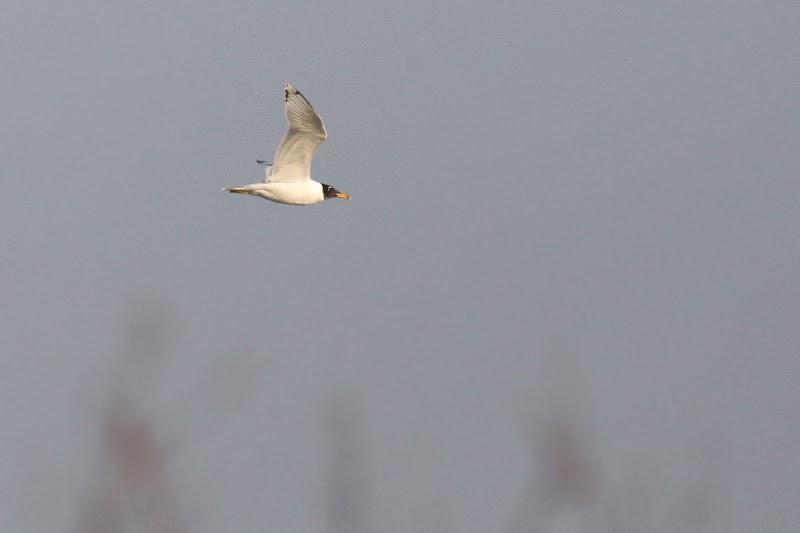
We stopped at the ‘Flamingo Lake’ to check the waterfowl and we were pretty surprised by the species richness. Among the ducks we saw Mallard, Gadwall, Pintail, Shoveler, Wigeon, Teal, Common and Red-creasted Pochard, Tufted Duck, Goldeneye and Smew. We counted 25 Bewick’s and 4 Whooper Swans, 5 Common Shelducks, 2 Black-necked Grebes, 19 Dalmatian Pelicans, 12 Flamingos, 3 Pallas’s Gulls, few Purple Swamphens and about 300 Coots. In the reeds we saw or heard at least 6 Cetti’s Warblers, several Caspian Reed Buntings, Penduline Tits and Bearded Reedlings. A Black Francolin flushed near the road.

Bird watching at the 'Flamingo Lake' © Michael Heiß
ad Pallas's Gull © Michael Heiß
Female Reed Bunting ssp. caspia © Michael Heiß
Male Reed Bunting ssp. caspia with an impressive bill © Michael Heiß

 And another one © Kai Gauger
Golden jackal in golden reed © Michael Heiß
In the evening we counted the roost flight from the ‘Lake House’. There were 744 Pygmy Cormorants, 205 Marsh Harriers, 40 Hen Harriers, 655 Magpies, 25.000-30.000 Rooks and Jackdaws in mixed flocks and tens of Meadow and coutelli Pipits with a calling Buff-bellied Pipit among them. An impressive flock of more then 40.000 Little Bustards was flying around in the distance. Unfortunately, we had to leave the Shirvan National Park. Due to the new regulations we were not allowed to spend the night there. So we could not camp at our favorite site at the ‘Flamingo Lake’ but did instead camping in the guestrooms of a friend’s restaurant.

The next morning we visited Shirvan again. The tracks in the park were dry, so we reached the coast. We checked the Caspian Sea and found 1 Velvet Scoter, 1 Red-throated and 1 Black-throated Diver, several Great Crested Grebes and a few waders and gulls including an ad heuglini. In the bushes we flushed 3 Black Francolins, a Long-eared and a Short-eared Owl and saw also 2 Long-legged and 1 Rough-legged Buzzard, 2 Peregrines, 1 Imperial Eagle and several White-tailed Eagles, Hen Harriers and Merlins. Just before we left the park we had once again great views on huge flocks of Little Bustards.

Flock of Little Bustards along the road © Michael Heiß
Some more Little Bustards and one of the oil pumps © Michael Heiß

Samstag, 3. Januar 2015

Mittwoch, 10. Dezember 2014

30 days bird migration at Besh Barmag


Text © Hans Olk, Fred Olk & Simon Olk
Photos ©  Fred Olk & Simon Olk

From the 10th of October till the 7th of November 2014 we visited Azerbaijan with the primary goal to study bird migration at the Besh Barmag bottle-neck. We are three birders from the Netherlands, at home we carry out different types of bird research, including migration counts. Plans for the trip were made after meeting Kai in Falsterbo, Sweden, in September 2013. He told us about the birds of Azerbaijan and especially the autumn migration and got us enthusiastic.

During the 30 days we visited Azerbaijan we also made a couple of short trips to other parts of the country. Gobustan, Shirvan NP, Gizil Agach and the Candy Cane Mountains were visited on one or more occasions. We rented a 4WD in Baku which turned out to be essential on several occasions. We slept in a small tent we brought from home and camped near the observation point. In total 212 species were seen during the trip.

Results migration counts Besh Barmag
Spread over 27 days we counted a total of 201 hours. The observation point was located on the coastal plain about 500 meters from the coastline of the Caspian Sea, approximately the same location Michael Heiss and Kai Gauger counted in October 2007 and Autumn 2012. We started our counts at first light and counted at least till 12 p.m. On most days we stopped when migration ended.
 
The observation point at Besh Barmag
During the hole period Black kites (40-50), Griffon (5) and Black vultures (30-40) and up to 10 Eastern imperial eagles were present nearby on the dump and flying around.
In total we counted 1.362.002 birds flying by, including north flying individuals. 154 species were identified actively migrating. The Common starling was the most counted species with a total of almost a million (963.756) individuals of which 289.040 passed on the 3th of November. Other species with over 25.000 individuals counted are: lark spec. (Sky/Calandra lark), Rook, Cormorant, Pygmy cormorant and Black-headed gull.
Impressive flock of Pygmy Cormorants
During the total 30-day-period we saw little sign of concentrated raptor migration. Only Sparrowhawk and Marsh and Hen harrier migrated in reasonably high numbers In the first two weeks some early migrating species were still seen. Barn swallow, Sand martin, wagtails, Blue-cheecked bee-eater, terns and for example Tawny pipit were seen. Towards the end other species became more numerous. For example different species of finches and buntings, thrushes, Jackdaws, Pygmy cormorants, Hen harriers and Little bustards increased in numbers.

Migrating Hen Harrier
Little Bustards resting in the steppe
Little Bustards in flight
During the night of 2-3 November temperatures dropped to 4°c. When we woke up it was windy and raining and there was snow visible on the top of the mountains. The weather would stay like this with northerly wind (bf 4-5) and low temperatures during the whole day. That day, within 8 hours, we counted 365.980 birds! Mostly Common starlings and larks but also 3281 Great egrets , 5 Lesser white fronted geese, 7 Pallid harriers and a Richard’s pipit passed. The next day it was still cold with a little less rain and wind and migration was still good with over 100.000 birds. Common starlings was again the most numerous specie (103.900), but also good numbers of Pygmy cormorant (2306), Marsh harrier (515), Hen harrier (190), Little bustards (51), two Dotterels, the first White-winged lark and three Great grey shrikes passed by. These days turned out to be the days with the most birds.

Great White Egrets flying through the Besh Barmag bottleneck
Levant Viper
 
Some other migration highlights
Besides the numbers of birds a couple of species got us excited or surprised:
·         Pygmy cormorant. The first were seen on the 16th of October (121) with numbers slowly building up to almost 10.000 on the 7th of November. Most of the time in large characteristic groups.
·         Dalmatian and Great white pelican. Seen in homogene, as well as mixed flocks. Total numbers of 156 Great white and 176 Dalmatic pelicans.
·         Little white-fronted goose. Spread over 4 days 85 birds were counted.
·         Sociable lapwing. Between a total of 5719 Northern lapwings 4 Sociable lapwings were found.
·         On the 5th of November 1555 Hawfinches passes in groups up to 100 birds. In total we counted 2351 Hawfinches.
·         On the 16th of October we were surprised by the presence of 3 Red-fronted serins which sat down in a low tree just in front of the observation point. From the 5th of November small numbers were present in the area and on the 7th of November a group of 15 birds flew by in southern direction.
·         Other interesting observations of migrating birds (with the total numbers): White-winged scooter (7), Saker (2), Little bustards (176), Caspian plover (1), Arctic skua (3), Black-bellied sandgrouse (35), Blue-cheecked bee-eater (508), White-winged lark (7), Richard’s pipit (6), Bearded tit/reedling (40) and Pine bunting (1).

Red-breasted Flycatcher
Dalmatian and White Pelican on migration
Dalmatian and White Pelican


Rare sightings
On the 11th of October the bushes were filled with resting passerines and between them a Dusky warbler was found. The bird was seen and heard well during the 5 minutes of observation. Most of the time the bird stayed low to ground and in the vegetation and unfortunately only some bad pictures were taken.
During a trip to the southern part of the country Kizil Agach was visited on the 31th of October were we surprisingly found a Grey phalarope between the waders at the beach. It took us some time to get close enough views to be sure it wasn’t a Red-necked phalarope but we obtained some decent photographs. About three kilometres to the south, also on the beach, we found a nice Desert wheatear. On the west site of Masalli a late Roller was present.
The Dusky warbler and Grey phalarope are rare and possibly even the first records for Azerbaijan.

Record shot of the Dusky Warbler
Grey Phalarope at Kizil Agach
Desert Wheatear on the beach at Kizil Agach

Overall we had a fantastic trip and we were sad we had to leave before the mass migration of Little bustards started. Also it would have been interesting to see how the migration would have continued for the rest of November and December. 

Dienstag, 18. November 2014

WOW!!!

Hans, Fred and Simon Olk from the Netherlands have been in Azerbaijan and did great migration birding at Besh Barmag.  Within less than a month they counted 1.3 million birds! Unfortunately they had to leave too early for the huge winter influx of Little Bustards and many others, but anyway they saw a lot. Amoung the best species were first records of Dusky Warbler and Grey Phalarope. More information about their trip coming soon.
See the complete numbers at trektellen:
http://www.trektellen.nl/totalen.asp?telpost=1533&jaar=2014&site=0&land=8&taal=2

Donnerstag, 15. Mai 2014

Azerbaijan Trip 5-13 May 2014

Text © Tomas Axén Haraldsson
Photos ©  Johan Stenlund

The third (following April 2012 and October 2013) arranged group trip by Swedish birders took place 5-13 May 2014 and included the highlights of eastern Azerbaijan: a few days in the Greater Caucasus, the steppes of Shirvan, the wetlands at Machmud Chala and Kizil Agach as well as the rich forests around Masalli.

Driving up through mountains and forests along the Guidalchay river yielded many Green Warblers and Semi-collared Flycatcher with Lammergeiers and Steppe Eagles overhead. The fogs were thick around Xinaliq but driving up to 2600m and then hiking, out of the fog, to some 2900m on the Gizilgaya massif proved successful - Caucasian Snowcock, Güldenstädt´s Redstart and a flock of Greater Rosefinches. 
 
Semi-collared Flycatcher
Green Warbler
The group then switched to next valley northwards and to Laza where they stayed with local families in the village on 1800m. An afternoon with Wallcreepers, Red-fronted Serins, Mountain Chiffchaffs, more vultures and eagles were followed by an exciting morning - eager swedish birders getting out of the houses at dawn and discover displaying Caucasian Black Grouses basically from the doorstep! Some 15 birds seen during the morning, on the slopes with birch scrub opposite Laza village and Suvar resort.
 
Red-fronted Serin
Wallcreeper
Short visits at the bottleneck site Besh Barmag with little result, some Rufous Bush-chats, Lesser Short-toed Larks, Menetriés Warblers.
 
Continuing south to Shirvan Nationalpark where the expected collection of birds showed - Black Francolin, Roller, Blue-cheeked Bee-eater, Ferrugineous Duck, Dalmatian Pelican. The wetlands at Machmud Chala are vast to overlook at a short visit but had some waders, 300 Greater Flamingoes and more. 

Rufous-tailed Scrub Robin
Blue-cheeked Bee-eater
The strips of oak forest south of Masalli proved yet again to be a safe bet for Shikra with a pair at breeding site seen on several visits. The team also searched for the elusive and semi-mythical Hyrcan Tit in the wooded foothills of the Talysh Mountains without finding it but well Middle Spotted and Syrian Woodpeckers. The smaller southern part of Kizil Agach lagoons had lots of waders including Terek and Broad-billed Sandpipers, Black-winged Pratincoles as well as thousands of Whiskered Terns and herons.
 
Shikra
Driving back to Baku with visit at the Gobustan petroglyphs and the local Rock Nuthatches and Pied Wheatears, but no Finch´s seen. All in all some 220 species during the week and with nice weather (perhaps a little too nice, many days with above 30°C!) and smooth logistics. We will come back to Aze thats for sure!

Thanks to Johan Stenlund for providing some photos (more: http://www.pbase.com/johanstenlund/azerbajdzjan_may_2014).

Tomas Haraldsson (planning and organizing the tour) & Ulf Ottosson (tour leader together with Elchin Sultanov).