Birdwatching news and bird photography from Azerbaijan- by Kai Gauger and Michael Heiß

Donnerstag, 26. Februar 2015

Winter trip 2015. The west: Varvara and dry Ajinohur region


Text © K. Gauger & M. Heiß

Coming from the south we had a short stop at the Aggöl entrance, but we could not enter the national park. We then decided to check the nearby steppes, but due to bad road conditions we did not much birding in this area. However, we saw our first Red-fronted Serins of this trip, 5000 Little Bustards, a Great Grey Shrike and along the channels we found several Cetti’s and Moustached Warblers.
 
Muddy dam near the Aggöl National Park © Pia Fetting
It is good to have 4WD © Michael Heiß

We drove further north and reached Varvara in the afternoon. Varvara is a water reservoir close to Mingecevir and offers excellent birding opportunities. Stops at the dam and the surrounding wetlands produced 3 Whooper Swans, 40 Ruddy Shelducks, 1 male Ferruginous Duck, 30 Dalmatian Pelicans, several Great and Pygmy Cormorants, 45 Black-crowned Night Herons, 1 Black Vulture, 1 White-tailed Eagle, more than 30 Black-winged Stilts, about 25 White-tailed Lapwings, 10 Black-tailed Godwits, 45 Armenian Gulls, 12 Pallas’s Gulls, 8 Whiskered Terns, 1 Grey Wagtail and a few Red-fronted Serins.

River sandbank full of birds and trees full of excrements © Kai Gauger
Distant Ferruginous Duck © Michael Heiß
Hunting Whiskered Tern © Kai Gauger
Pygmy Cormorant © Kai Gauger
Black-crowned Night Heron © Michael Heiß
White-tailed Lapwing © Kai Gauger

Black-winged Stilt © Kai Gauger

We spent the night in a hotel in Mingecevir. The next day we birded around Mingecevir but found nothing special. Aftrer a stop at the huge bazar in the city we drove further to the reservoir. Unfortunately, the water level of the lake was too low to see any birds from the dam. So we wasted no time in this area and drove to the Ajinohur. But here we had the same problem. The lake was empty and the surrounding steppes were extremly dry, a result of a long-lasting drought. No waterbirds at all was a pity. Also the other birdlife was suffering from the bad conditions and we saw just 4 Black Vultures, 2 Imperial Eagles, 3 Hen Harriers, 6 Long-legged Buzzards, 1 Peregrine, 2 Little Bustards, 15 Lesser Short-toed Larks, 3000 Calandra Larks, 40 Mistle Thrushes, 2 Ring Ouzels and about 15 Rock Sparrows.

Usually, there is water and some birds in the Mingecevir reservior © Pia Fetting
The Ajinohur lake was also empty © Michael Heiß
Calandra Larks, but no White-winged or Black Larks among them © Michael Heiß
Peregrine © Kai Gauger
Peregrine in flight © Kai Gauger
Goitered Gazelles from the reintroduction program © Kai Gauger
Ring Ouzel © Lukas Pelikan
Preparing the camp fire © Michael Heiß
Enjoying the camp fire © Michael Heiß
Working at the camp fire © Michael Heiß
We spent the night in tents close to the Mingecevir reservoir. In the morning we saw 7 Greater White-fronted and 30 Greylag Geese, more than 35 Ruddy Shelducks, 2 Black-necked Grebes, 1 Armenian and 5 Pallas’s Gulls. Once again we heard an overflying Red-fronted Serin. Close to the Georgian border we flushed 3 Black Francolins and saw about 10 Syrian Woodpeckers. In the bushes Hawfinches, Chaffinches, Bramblings, Robins, Blue, Great and Long-tailed Tits, Goldcreast and Blackbirds were common. We also had 1 Chiffchaff, 4 Bullfinches, 2 Fieldfares and a Redwing.
A drive through the steppe around the Ajinohur Lake produced a homeyeri Great Grey Shrike, 650 Little Bustards, about 500 Calandra Larks and 150 Mistle Thrushes.
We left the Ajinohur region a bit disappointed, missing the huge flocks of Little Bustards, Red-fronted Serins, larks, Flamingos or geese we saw in 2010.
 
Camping site © Michael Heiß
Long-legged Buzzard © Kai Gauger
Merlin in the steppe © Michael Heiß
homeyeri Great Grey Shrike © Kai Gauger
Birding stop © Pia Fetting
Birding stop © Steve Klasan
You can make Shashlik out of these...© Michael Heiß
...but Fat-tailed Sheep are never alone © Michael Heiß

Donnerstag, 19. Februar 2015

Winter trip 2015. The south: Mahmudchala, Kizil Agach and Talysh

Text © K. Gauger & M. Heiß

After leaving Shirvan we had a short stop at the fishponds north of Salyan. Unfortunately, there were only a few birds but among them a dozen Great Black-headed Gulls. The gull friends of our group could not get around the burning dump where they saw about hundred large gulls and two Black Kites.


Great Black-headed Gulls © Kai Gauger
Not really a nice birding site © Michael Heiß
Where are we? © Michael Heiß
At Mahmudchala there were again huge numbers of ducks of all species and we estimated about 12.000 birds in total. Among those which were close enough to tell apart we found 80 Ferruginous Ducks and 5 Marbled Teals but no White-headed Duck. In the bushes were several Chiffchaffs and a nice Bluethroat. Along the channel we saw Wood Sandpipers, Greenshanks, Snipes, Water Rail and some Water Pipits. Just before dusk we went on to Masalli where we stayed in a hotel.

The entire next day we were birding in Kizil Agach. In the lagoons and along the dam we saw many waders (1300 Avocets, 165 Godwits, sandpipers, stints, plover, Curlew), herons, Pygmy Cormorants, grebes, some ducks, typical songbirds (Chiffchaffs, Cettis, coutelli-Pipits,...) and a couple of Whiskered Terns. As always there was intensive hunting on the bay with hundreds of shots. The results can be bought on the main road. It's unbelievable but this massacre will go on until they shot the last remaining coot and duck. We also found nets for waders and wader lures. That they go for more but waterfowl was new for me.

Birding along the dam to Nerimanabad © Michael Heiß
Bluethroat at the dam © Michael Heiß
Whiskered Tern with probable Syrian Spadefoot © Michael Heiß
Birding hide with three steel Curlews © Michael Heiß
The coast was very nice with about 1000 Dunlins among we found a single Broad-billed Sandpiper, 150 Ringed, 50 Kentish and 70 Grey Plovers, more than 60 Dalmatian Pelicans at close range, 40 Smews, 60 Slender-billed and 30 Great Black-headed and 60 large Gulls. But the bird of the day was sound recorded and proved to be a Buff-bellied Pipit!


During the day we also saw a Peregrine, 4 Short-eared Owls and a Great Bittern.

Having fun with the cars © Michael Heiß
Dalmatian Pelican © Michael Heiß
Dalmatian Pelicans at the beach © Kai Gauger
Two hunting Short-eared Owls © Michael Heiß
 
About 20 hunters were selling ducks, coots and grebes 
along the roadside © Kai Gauger
We spent the night in the beautiful Təbəssüm resort on the way to Lerik where we got great food and some nice cottages. The next morning we did a walk in the forest and saw several new species for our list. Most interesting for those who were here for the first time were the many Talysh-subspecies, including poelzami-Woodpecker.

Preparing Shashlik at Təbəssüm © Michael Heiß
Birding in Talysh forest © Michael Heiß

poelzami-Woodpecker © Lukas Pelikan
Robin with a red tail © Lukas Pelikan
Flowering cyclamen © Michael Heiß
The Talysh Mountains © Michael Heiß

Afterwards we started the long drive through the lowland. Near Celilabad we were attracted by many birds flying around over the fields. It was the dump of a small chicken farm and after a dirty drive through a village we found the place where we saw 200 White Storks, 4 Imperial Eagles, 5 Long-legged Buzzards and some gulls.The road along the Iranian border turned out to be in a very bad condition and so we didn't reach Ag-Gel in the evening. We piched our tents close to a village in the nowhere. Besides the nerve-racking barking of the local dogs we heard many Golden Jackals and several times a wolf.

A few of 200 White Storks at the dump of a chicken farm © Kai Gauger
4 Imperial Eagles were around as well © Kai Gauger
It's always good to have rubber boots and 4WD in winter © Michael Heiß

Donnerstag, 12. Februar 2015

Winter trip 2015. First days: Gobustan and Shirvan National Park

Text © K. Gauger & M. Heiß

Arriving at Baku Airport in the early morning of 16th January we immediately received our cars, which have been organised by our tour operator Kaspian Tur. For the ten participants of the trip we rented three 4WD cars. After a brief instruction we had a nice night drive through Baku city just before the rush hour started.

Our first stop was at the famous Gobustan rock engravings. These are thought to be impressive 5.000 to 40.000 years old. Besides the outstanding cultural value the spot is also excellent for bird watching. The rocks are year-round highly attractive to a large variety of species, especially rock-specialists like Rock Nuthatches that were audible everywhere, Rock Buntings of which we saw 7 in a flock or 2 pairs of Finsch’s Wheatear.

Rock formations in Gobustan © Michael Heiß
Rock Bunting © Kai Gauger
Western Rock Nuthatch © Kai Gauger
Crested Lark © Kai Gauger
Some wintering species were in the rocks as well: Chaffinch, Sparrow Hawk, Wren, Dunnock, Robin, Song Thrush, Redwing, 2 Goldcrests, 7 Wood Larks and more than 20 Black Redstarts. Pairs of Red-billed Choughs flew over and a pair of Spanish Sparrows showed up well at the visitors centre. Nevertheless, we missed the Wallcreeper that we have seen on our last wintertrip in 2010.

We headed further south for the next stop in the Shirvan National Park. Several groups of gazelles were around as usual but two distant wolves were a nice surprise. Among the passerines we found mainly Corn Buntings, Meadow Pipits and Common Linnets. Hen Harriers and Merlins were frequent. A first flock of about 3.000 Little Bustards flew in some distance. A stop in the steppe produced flocks of larks, dominated by Skylark and Calandra Lark, but also 3 or 4 White-winged Larks were among them. This species was a main target for some of us but unfortunately only a few saw them. 9 Lesser White-fronted Geese were among hundreds of Greater White-fronted and Greylag Geese. 

Roadside birding without birds © Lukas Pelikan
Roadside birding with Little Bustards © Michael Heiß
Always drive slowly when Little Bustards cross the road © Lukas Pelikan
Goitered Gazelles © Michael Heiß
We stopped at the ‘Flamingo Lake’ to check the waterfowl and we were pretty surprised by the species richness. Among the ducks we saw Mallard, Gadwall, Pintail, Shoveler, Wigeon, Teal, Common and Red-creasted Pochard, Tufted Duck, Goldeneye and Smew. We counted 25 Bewick’s and 4 Whooper Swans, 5 Common Shelducks, 2 Black-necked Grebes, 19 Dalmatian Pelicans, 12 Flamingos, 3 Pallas’s Gulls, few Purple Swamphens and about 300 Coots. In the reeds we saw or heard at least 6 Cetti’s Warblers, several Caspian Reed Buntings, Penduline Tits and Bearded Reedlings. A Black Francolin flushed near the road.

Bird watching at the 'Flamingo Lake' © Michael Heiß
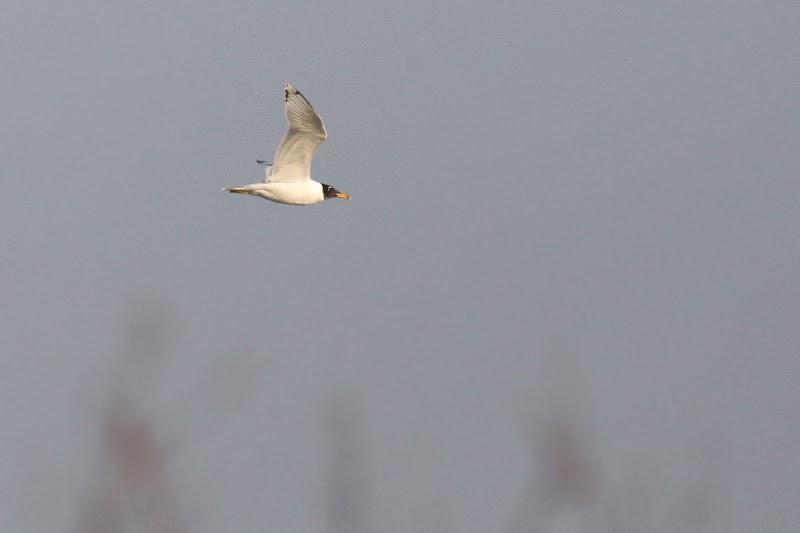
ad Pallas's Gull © Michael Heiß
Female Reed Bunting ssp. caspia © Michael Heiß
Male Reed Bunting ssp. caspia with an impressive bill © Michael Heiß

 And another one © Kai Gauger
Golden jackal in golden reed © Michael Heiß
In the evening we counted the roost flight from the ‘Lake House’. There were 744 Pygmy Cormorants, 205 Marsh Harriers, 40 Hen Harriers, 655 Magpies, 25.000-30.000 Rooks and Jackdaws in mixed flocks and tens of Meadow and coutelli Pipits with a calling Buff-bellied Pipit among them. An impressive flock of more then 40.000 Little Bustards was flying around in the distance. Unfortunately, we had to leave the Shirvan National Park. Due to the new regulations we were not allowed to spend the night there. So we could not camp at our favorite site at the ‘Flamingo Lake’ but did instead camping in the guestrooms of a friend’s restaurant.

The next morning we visited Shirvan again. The tracks in the park were dry, so we reached the coast. We checked the Caspian Sea and found 1 Velvet Scoter, 1 Red-throated and 1 Black-throated Diver, several Great Crested Grebes and a few waders and gulls including an ad heuglini. In the bushes we flushed 3 Black Francolins, a Long-eared and a Short-eared Owl and saw also 2 Long-legged and 1 Rough-legged Buzzard, 2 Peregrines, 1 Imperial Eagle and several White-tailed Eagles, Hen Harriers and Merlins. Just before we left the park we had once again great views on huge flocks of Little Bustards.

Flock of Little Bustards along the road © Michael Heiß
Some more Little Bustards and one of the oil pumps © Michael Heiß

Samstag, 3. Januar 2015